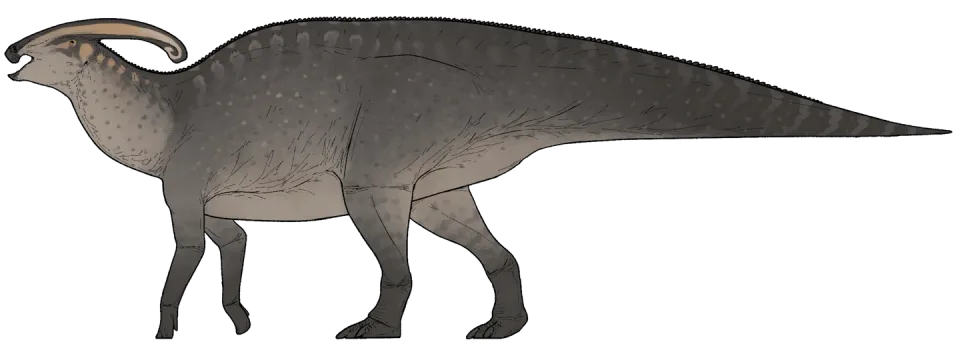
Parasaurolophus walkeri
Parasaurolophus walkeri
Description
Parasaurolophus was a bipedal, herbivorous ornithischean dinosaur that dwelt in what would become the North American midwest during the late Cretaceous period. It is recognizable for the long, blunt crest protruding from the back of its skull. Although the exact purpose of this crest is a matter of some debate, aesthetic value, temperature regulation, and even vocalization have all been proposed as possible uses for the formation.Parasaurolophus could walk on two or four legs, depending on the situation. It was 30 feet long, fully grown.In art, Parasaurolophus is often discerned by its beak and distinctive crest, which varies in length as determined by the species depicted.
Habitat
Fossil Distribution
Parasaurolophus was a herbivore. It lived in the Cretaceous period and inhabited North America. Its fossils have been found in places such as Alberta (Canada), New Mexico and Arizona.
Taxonomy
Fun Facts
Parasaurolophus walkeri is mapped from PBDB occurrence occ:467016 in Dinosaur Park, Canada; interval Late Campanian (83.6-72.2 Ma).
PBDB interval: Late Campanian (83.6-72.2 Ma).
Fossil occurrence locality: badlands of Red Deer River, middle branch of coulee below Sand Creek, 125 feet (aneroid) above river, about 0.5 miles W of Crown & 10 miles below Steveville; E 1/2, sec 5, T21, R11, LSD 4.
Formation/group: Dinosaur Park.
PBDB ecology: diet herbivore, habit ground dwelling, gregarious.