Description
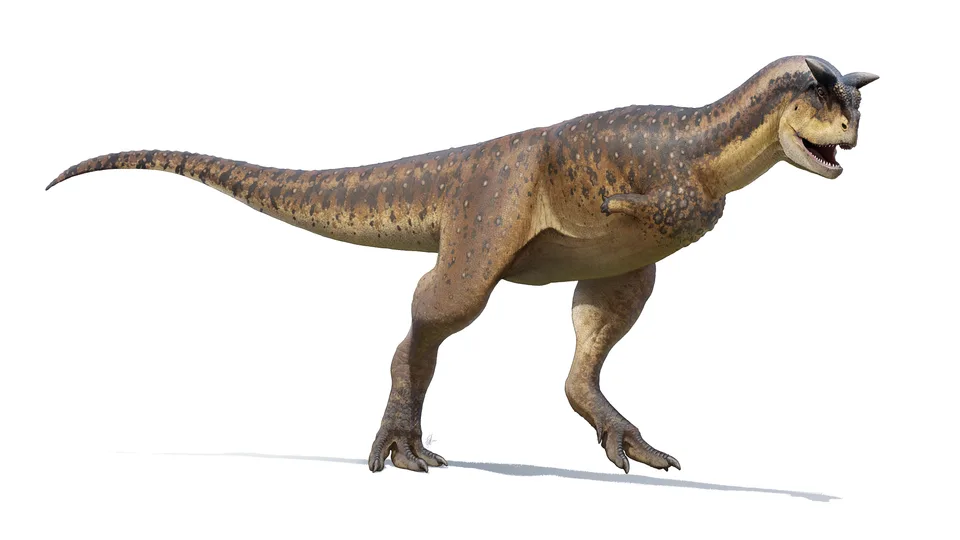
Carnotaurus was a carnivorous theropod that dwelled in what would become South America during the late Cretaceous period. Its name means “meat-eating bull”, and it resembles a Tyrannosaur with horns.Scientists have been fortunate to have recovered a remarkably well-preserved skeleton of a Carnotaurus, which they have used to glean many insights not only into that genus but also many other theropods. Carnotaurus has the smallest forelimbs of all theropods, smaller even than those of the notoriously small-armed Tyrannorsaurus Rex. It is thought that the arms may have been entirely vestigial, serving no practical function, unlike the T. Rex’s arms, which are now suspected to have been functional.In art, the Carnotaurus is shown with wide variety of skin colors and patterns, but can be recognized easily by the horns protruding from above its eyes, and its noticeably stubby forelimbs.
Habitat
Fossil Distribution
Carnotaurus was a carnivore. It lived in the Cretaceous period and inhabited South America. Its fossils have been found in places such as Argentina.
Taxonomy
Fun Facts
Carnotaurus sastrei is mapped from PBDB occurrence occ:263808 in La Colonia, Argentina; interval Late Maastrichtian (72.2-66 Ma).
PBDB interval: Late Maastrichtian (72.2-66 Ma).
Fossil occurrence locality: Estancia Pocho Sastre near Bajada Moreno, Chubut.
Formation/group: La Colonia.
PBDB ecology: diet carnivore, habit ground dwelling, solitary.